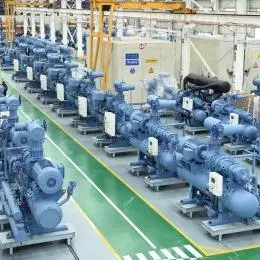
This is why selecting a water chiller requires more than comparing nominal capacity. The important question is whether the unit can maintain the required leaving-water temperature and cooling output when the site reaches its most demanding operating conditions.
The difference is especially important in industrial applications where cooling demand changes throughout the day. For example, a chiller plant for concrete batching plant operation may need to handle hot incoming water, high summer ambient temperatures, fluctuating batching schedules, and sudden increases in chilled-water demand. Evaluating these conditions before equipment selection helps avoid a system that appears adequately sized but cannot maintain stable performance after installation.
Actual Cooling Output After the Chiller Is Installed
Rated cooling capacity provides a useful reference point, but it should not be treated as a guaranteed output under every site condition. Chiller performance depends on the temperatures and flow rates on both the evaporator and condenser sides, as well as the operating characteristics of the compressor and heat exchangers.
Once the equipment is installed, the available capacity may change as these conditions move away from the rating point. Higher condenser temperatures make the compressor work against a greater temperature difference. Changes in chilled-water temperature affect evaporator conditions. Unstable flow can reduce effective heat transfer. Together, these factors explain why two installations using similar water chiller equipment can deliver different results in practice.
For industrial projects, the better approach is to define the actual duty before selecting equipment. The supplier should understand the required chilled-water supply temperature, expected return-water temperature, process flow, ambient conditions, operating schedule, and peak cooling requirement.
This is particularly important when designing a chiller plant for concrete batching plant use. Concrete production is rarely a perfectly constant process. Demand may rise sharply during intensive batching periods and fall when production slows. A system should therefore be evaluated against the real production schedule rather than only an average daily cooling load.
| Operating Factor | Favourable Condition | Condition That Can Reduce Performance | Design Response |
|---|---|---|---|
| Chilled-Water Temperature | Operating close to the selected design condition | Requiring substantially colder water than the original rating condition | Select capacity according to the actual required leaving-water temperature |
| Evaporator Flow | Stable flow within the equipment's intended operating range | Insufficient, unstable, or poorly balanced flow | Correct pump sizing, balancing, controls, and hydraulic design |
| Condenser Environment | Good heat rejection and unrestricted airflow or water flow | High ambient temperature, recirculated hot air, or poor condenser-water conditions | Size the condenser for the actual site and provide suitable ventilation or water management |
| Heat Exchanger Condition | Clean heat-transfer surfaces | Scale, sediment, biological fouling, or blocked airflow | Water treatment, inspection, cleaning, and preventive maintenance |
| Cooling Load | Load remains within the chiller's controllable operating range | Frequent extreme peaks or prolonged very low load | Use suitable staging, capacity control, buffering, or multiple-unit configuration |
Water Temperature Conditions That Change Available Cooling Capacity
Water temperature has a direct influence on chiller operation. On the evaporator side, the unit removes heat from returning process water and supplies it back to the application at a lower temperature. The required relationship between entering and leaving water therefore determines part of the cooling duty.
A more demanding leaving-water temperature can change the refrigeration conditions under which the compressor and evaporator operate. This means a water chiller selected for one chilled-water temperature should not automatically be assumed to provide the same capacity when substantially colder water is required.
Return-water temperature also changes with the process. During periods of heavy production, warmer return water can increase the instantaneous cooling load. During light operation, the temperature difference may become smaller and the chiller may run at partial load.
For concrete cooling, this relationship should be reviewed alongside batching requirements. The cooling system does not operate independently from the concrete process. Mixing-water volume, initial water temperature, batching frequency, aggregate temperature, and the required concrete discharge condition all influence how much cooling is needed.
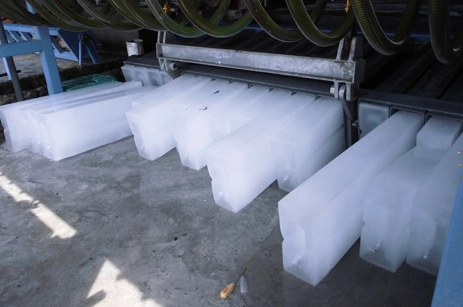
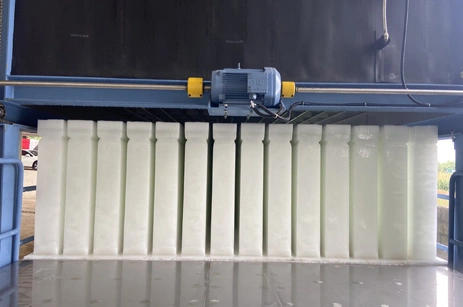
FSE uses water chilling as one part of its broader concrete cooling approach, alongside ice production and aggregate cooling where the project requires additional temperature reduction. For large or demanding applications, reviewing the complete FSE cooling solution can help determine whether chilled water alone is sufficient or should be integrated with other cooling methods.
Flow Stability Through the Evaporator and Distribution Loop
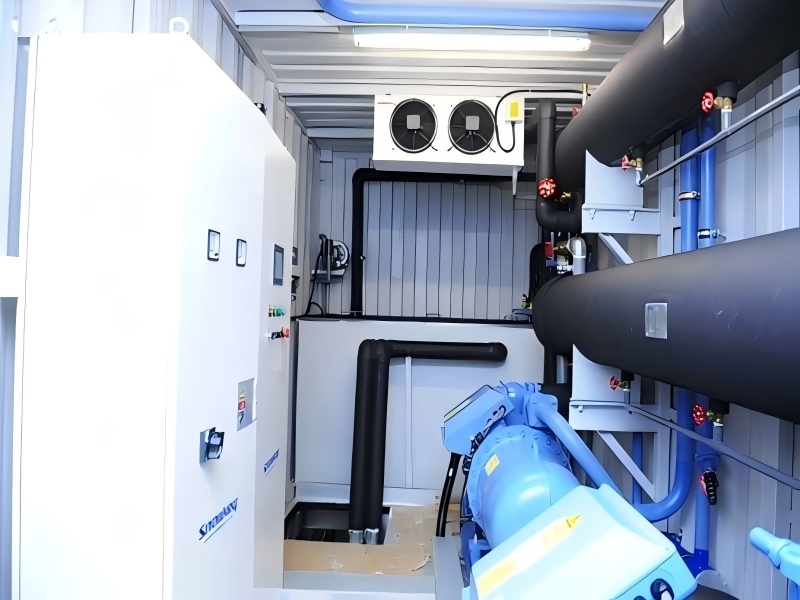
A chiller can only remove heat effectively when the process water passes through the evaporator under suitable flow conditions. Flow that is too low, unstable, or unevenly distributed can interfere with heat transfer and make leaving-water temperature more difficult to control.
The problem is often outside the water chiller itself. Incorrect pump selection, partially closed valves, blocked strainers, poor pipe sizing, air in the water loop, or an unbalanced distribution system can all change the flow reaching the evaporator.
For this reason, hydraulic design should be considered as part of cooling-system design rather than as a separate piping task. Pumps should be matched to the required flow and system resistance, while the distribution loop should deliver water reliably to both the chiller and the process.
A chiller plant for concrete batching plant may face additional flow variation because batching demand is intermittent. If chilled water is withdrawn rapidly during production and then demand falls between batches, the water circuit and controls need to accommodate these changes without causing unstable chiller operation.
A chilled-water buffer tank can be useful in applications where process demand changes faster than the chiller can respond comfortably. The tank separates short process peaks from refrigeration production to some extent, allowing the cooling equipment to operate under more stable conditions. Whether buffering is required depends on the load profile, water volume in the system, chiller configuration, and control strategy.
Condenser Heat Rejection in Hot or Poorly Ventilated Sites
The evaporator absorbs heat from the chilled-water circuit, but that heat still has to leave the refrigeration system. The condenser rejects both the heat collected from the process and the heat associated with compressor operation. If heat rejection becomes difficult, cooling performance can deteriorate even when the evaporator side appears correctly designed.
This is a common concern with air-cooled equipment installed in hot climates. High outdoor temperatures already increase the condenser's operating challenge. If the unit is then installed close to walls, under a poorly ventilated enclosure, or where hot discharge air can return to the condenser inlet, the effective entering-air condition can become even more severe.
As condensing conditions rise, compressor workload generally increases while available refrigeration capacity may decrease. An industrial water chiller intended for a demanding outdoor site should therefore be selected using realistic maximum ambient conditions rather than only comfortable average temperatures.
Water-cooled condenser systems face a different set of considerations. Cooling-water temperature, water flow, cooling-tower performance, water treatment, and condenser-tube cleanliness all affect heat rejection. The choice between air-cooled and water-cooled configurations should therefore reflect local climate, available infrastructure, water resources, maintenance capability, and plant scale.
These factors become particularly important for a chiller plant for concrete batching plant located on a hot construction site. Concrete cooling demand is often greatest during the same high-temperature periods that make condenser heat rejection more difficult. Designing for the real summer operating condition provides a better basis for reliable capacity than selecting equipment from nominal output alone.
Capacity Loss from Scale, Fouling, and Reduced Heat Transfer
Heat exchangers depend on clean surfaces to transfer heat efficiently. Over time, scale, sediment, biological deposits, corrosion products, or other contamination can add thermal resistance between the water and the heat exchanger surface.
ASHRAE refrigeration guidance identifies fouling as an important factor in condenser and chiller performance. As fouling increases, greater temperature difference is needed to transfer the same amount of heat. In practice, this can increase refrigeration-system pressure and energy consumption or reduce available capacity.
Water quality therefore affects more than equipment cleanliness. It can influence the long-term cooling performance of a water chiller. Sites with hard water or challenging cooling-water conditions should consider suitable filtration, water treatment, inspection, and cleaning from the beginning of the project.
Air-cooled condensers also lose performance when dust or debris accumulates on the coil and restricts airflow. Construction environments can be particularly demanding because airborne dust can build up faster than it would in a clean mechanical room.
Maintenance planning should therefore be based on the actual site rather than a generic interval. Pressure readings, approach temperatures, flow conditions, water quality, and visible heat-exchanger condition can help operators identify deterioration before it becomes a serious capacity problem.
For a chiller plant for concrete batching plant, this is especially relevant because equipment may operate close to cement handling, aggregate storage, earthworks, and other sources of dust. Providing service access and establishing practical cleaning routines during the design stage makes it easier to preserve cooling performance over the life of the project.
Cooling Performance During Partial and Variable Load Operation
Industrial chillers rarely operate at exactly full load throughout every working hour. Cooling demand changes as production starts and stops, process temperatures vary, and different pieces of equipment come online. How the system behaves under these partial-load conditions has a major influence on actual efficiency.
A correctly designed water chiller should be able to adjust capacity without creating excessive temperature fluctuations or unnecessary compressor cycling. The appropriate method depends on the compressor technology and overall system design. Multiple compressors, staged operation, variable-speed control, and other capacity-control methods can be used to match refrigeration output more closely to demand.
ASHRAE guidance on chiller-system control also highlights the importance of chiller sequencing and load distribution when several units operate together. Proper staging allows the operating equipment to carry the required load without unnecessarily running additional chillers at inefficient conditions.
For projects with a wide difference between average and peak cooling demand, using multiple chillers can provide additional operating flexibility. During light production, fewer units can operate. Additional capacity can then be brought online as load increases. Whether this arrangement is preferable to a single larger chiller depends on project size, redundancy requirements, capital cost, maintenance strategy, and the expected load profile.
A well-designed chiller plant for concrete batching plant should therefore be evaluated across the complete batching cycle rather than only at maximum production. Stable chilled-water temperature, appropriate storage volume, sensible equipment staging, and responsive controls all contribute to reliable cooling when batching frequency changes.
FSE designs industrial cooling equipment around project conditions, including application requirements, water temperature, cooling demand, climate, installation environment, and system configuration. Matching these factors early in the design process is more reliable than correcting a capacity shortfall after commissioning.
Conclusion
Real cooling capacity is determined by the complete operating environment, not by one figure on a specification sheet. Chilled-water temperatures, evaporator flow, condenser heat rejection, heat-exchanger cleanliness, piping design, process demand, and control strategy all influence how much useful cooling a water chiller can deliver after installation.
For concrete cooling, the relationship between the chiller and the production process is particularly important. A reliable chiller plant for concrete batching plant should be selected around actual batching demand, peak ambient conditions, water temperatures, hydraulic requirements, and expected load variation. Where chilled water alone cannot meet the project temperature target efficiently, ice production or aggregate cooling can also be considered as part of the wider cooling system.
If you are planning a new cooling installation or reviewing an existing system that is not achieving its expected output, FSE can assess the operating conditions and recommend an appropriate equipment configuration. Contact FSE to discuss your water chiller and concrete cooling requirements.
Frequently Asked Questions
1. Why is actual water chiller capacity different from rated capacity?
Rated capacity is based on specified test conditions. Actual output can change with chilled-water temperature, condenser conditions, water flow, ambient temperature, fouling, and process load after installation.
2. Does lower chilled-water temperature reduce chiller capacity?
It can. Requiring colder leaving water changes the refrigeration operating condition and may reduce the capacity available from the same equipment. Capacity should always be checked at the actual required water temperature.
3. Can insufficient water flow reduce cooling performance?
Yes. Inadequate or unstable evaporator flow can reduce heat transfer and interfere with temperature control. Pump selection, pipe sizing, valve position, strainers, and system balancing should all be checked when flow problems occur.
4. Why does chiller performance decline in hot weather?
Higher ambient or condenser-water temperatures make heat rejection more difficult. This can raise condensing conditions, increase compressor workload, and reduce available cooling capacity.
5. How does scale affect water chiller performance?
Scale creates additional resistance to heat transfer. As deposits build up, the system may require more energy to provide the same cooling duty, while available capacity can decrease. Proper water treatment and heat-exchanger cleaning help control this problem.
6. How should a chiller plant for concrete batching plant be sized?
It should be based on required chilled-water temperature, water volume per batch, initial water temperature, batching frequency, peak production rate, ambient conditions, storage or buffer capacity, and the overall concrete temperature-control strategy.