search
Managing thermal energy rejection efficiently is a foundational requirement for modern heavy industries, commercial cold storage, and chemical processing facilities. As global energy costs rise and water-use regulations tighten, industrial operators require heat rejection systems that balance thermal performance with resource conservation. Among the available technologies, industrial evaporative condensers represent a highly efficient solution, combining the physical principles of both air cooling and water cooling into a single, compact system.
Understanding the diverse evaporative condenser uses and system integration methodologies is essential for engineering procurement managers, plant operators, and facility designers. Working with established evaporative condenser manufacturers allows enterprises to deploy tailored heat rejection hardware that reduces total cost of ownership while maintaining stable head pressures under extreme seasonal conditions.
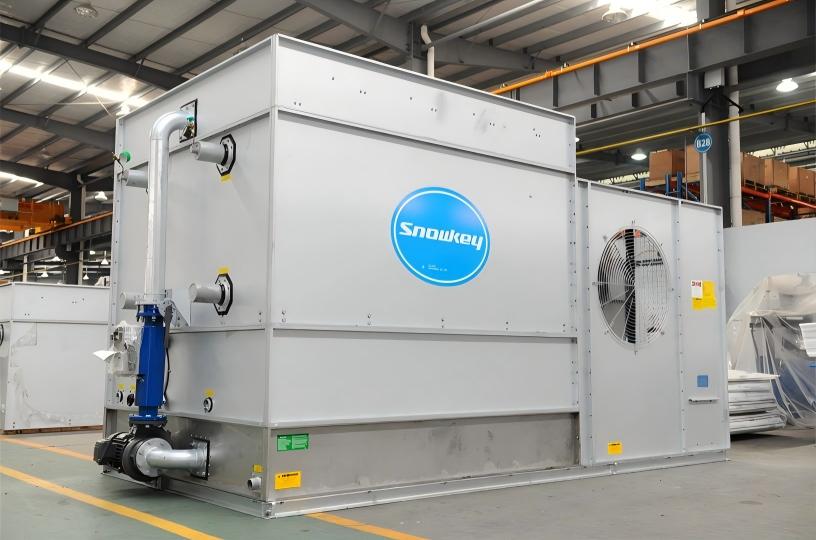
The primary function of an evaporative type condenser is to reject heat from a high-pressure, high-temperature refrigerant vapor and condense it into a subcooled liquid. Unlike traditional air-cooled systems that rely solely on sensible heat transfer, or water-cooled shell-and-tube systems that require independent, external cooling towers, an evaporative condenser integrates the heat-rejection process directly within a single piece of hardware.
The underlying thermodynamic mechanism relies heavily on latent heat of vaporization. The basic process follows a structured path of airflow, fluid circulation, and heat transfer:
High-pressure refrigerant vapor circulates continuously through the internal heat exchange coils.
A water distribution system continuously sprays a thin layer of water over the external surfaces of these coils.
Simultaneously, heavy-duty axial or centrifugal fans draw large volumes of ambient air downward or upward through the cascading water film.
As the moving air meets the wet coil surfaces, a small portion of the circulating water evaporates. This evaporation removes large amounts of latent heat directly from the coil wall, causing the internal refrigerant vapor to rapidly condense into liquid form.
The total heat rejected through this process is calculated by the sum of air sensible heat transfer and water latent heat transfer:
Total Heat Rejection = Sensible Heat from Air Flow + Latent Heat of Water Evaporation
By utilizing the wet-bulb temperature of the ambient air rather than the dry-bulb temperature, evaporative cooling systems achieve a significantly lower condensing temperature. This thermodynamic advantage directly reduces the compressor's workload, resulting in substantial power savings across the entire refrigeration loop.
The thermodynamic efficiency and compact design of these systems make them highly versatile across several capital-intensive industries. Industrial evaporative condenser uses span multiple sectors where uninterrupted temperature control is non-negotiable.
| Industry Sector | Primary Application | Critical Requirement |
|---|---|---|
| Cold Chain Logistics | Large-Scale Commercial Cold Storage | Stable Condensing Pressures |
| Food & Beverage Processing | Blast Freezing & Food Processing Facilities | High Hygiene & Minimal Downtime |
| Chemical & Petrochemical | Process Fluid Cooling & Gas Liquefaction | Explosion-Proof & Heavy-Duty Coils |
| Industrial Manufacturing | Concrete Cooling & Laser Equipment Chilling | Reliable Continuous Heat Rejection |
Large-scale distribution centers and commercial food warehouses require reliable, 24/7 refrigeration to prevent product spoilage. Evaporative condensers are highly suited for these facilities because they maintain stable head pressures even during peak summer ambient temperature spikes. This stability protects expensive screw and reciprocating compressors from over-pressurization and thermal stress.
From industrial dairies and breweries to large-scale poultry, meat, and seafood processing facilities, temperature regulation dictates product safety and shelf life. Evaporative cooling hardware is utilized to manage the massive thermal loads generated by deep blast freezers, spiral freezers, and pasteurization tunnels, ensuring continuous operation with low energy inputs.
Chemical synthesis and pharmaceutical compounding frequently generate exothermic reactions that require rapid, controlled heat extraction. Industrial evaporative systems are designed with heavy-duty galvanized steel or stainless steel alloy structures to handle hazardous process fluids and volatile refrigerants safely, minimizing risk in demanding chemical environments.
Sustainability mandates are pushing global industries away from traditional hydrofluorocarbons (HFCs) toward natural refrigerants, most notably Ammonia (R717) and Carbon Dioxide (R744). Integrating evaporative condensers into these systems is critical for safety, efficiency, and regulatory compliance.
Ammonia is an exceptionally efficient natural refrigerant with zero Ozone Depletion Potential (ODP) and zero Global Warming Potential (GWP). However, R717 systems operate under high discharge temperatures. If the condensing temperature rises due to inefficient heat rejection, discharge temperatures can exceed safe thresholds, leading to oil degradation, compressor wear, and potential system pressure relief events.
Leading evaporative condenser manufacturers engineer specialized heat exchange coils specifically designed to handle the high pressures and chemical characteristics of ammonia. By pairing a countercurrent evaporative heat exchanger with an R717 loop, operators can ensure the refrigerant remains within tight pressure-temperature envelopes. The high latent heat capacity of water evaporation complements the high latent heat of vaporization of ammonia, maximizing the overall Coefficient of Performance (COP) of large-scale industrial plants.
Many older industrial manufacturing facilities rely on legacy heat rejection setups consisting of separate cooling towers paired with shell-and-tube condensers. These older configurations often suffer from multiple operational inefficiencies:
High maintenance demands due to extensive internal piping networks and multiple water pumps.
Massive water losses resulting from high drift rates and poor water distribution control.
Excessive scaling and biofilm accumulation inside the shell-and-tube heat exchangers, which degrades thermal conductivity over time.
Retrofitting these older configurations with integrated evaporative condensers offers a clear upgrade path. Replacing multiple pieces of equipment with a single, self-contained evaporative unit eliminates the middle water-circulation loop. This structural reduction eliminates the energy consumed by large condenser water pumps, lowers the total system water volume, and reduces the physical footprint required in the mechanical yard or on the facility roof.
Furthermore, integrating smart automation during a retrofit maximizes resource conservation. Implementing Variable Frequency Drive (VFD) fan controls allows the condenser fans to adjust their rotational speed dynamically based on real-time head pressures and ambient wet-bulb temperatures. During cooler evening hours or partial-load scenarios, the fans slow down, minimizing power consumption and reducing airborne drift losses, balancing resource consumption with cooling output.
Fujian FSE Supply Chain Management CO., Ltd. (FSE) is a comprehensive industrial platform specializing in heavy-duty cold chain hardware, automated manufacturing assets, and tailored turnkey supply chain solutions. We reject one-size-fits-all mentalities, delivering highly customized industrial heat rejection assets engineered to excel under extreme operational demands.
Our CSAC series evaporative condensers feature a high-efficiency countercurrent design that optimizes heat transfer across various refrigerants. Crucially, FSE solves the common logistical bottlenecks of overseas procurement. The CSAC series is purposefully engineered for containerized transportation, fitting seamlessly into 20-foot to 40-foot containers. The equipment easily disassembles into three sub-assemblies for shipping, which minimizes ocean freight costs and dramatically accelerates on-site installation and deployment.
To see how our engineering designs integrate into large-scale factories, visit our FSE Solutions Page. If you are ready to implement an energy-efficient cooling loop backed by reliable thermodynamic load calculations, reach out directly through our FSE Contact Page.
Industrial evaporative condenser uses across cold chain logistics, food processing, and chemical manufacturing demonstrate the technology's value in high-demand settings. By leveraging ambient wet-bulb temperatures and the physics of water evaporation, these units provide high heat-rejection efficiency while reducing power and water consumption. Partnering with a specialized supplier like FSE allows industrial operators to secure modular, energy-efficient cooling assets that lower total cost of ownership and protect critical production processes for decades.
An evaporative condenser contains the refrigerant coils directly inside the unit, condensing the gas in a single step using airflow and sprayed water. A cooling tower cools an external water loop, which must then be pumped to a separate shell-and-tube condenser inside the facility to cool the refrigerant.
Variable Frequency Drive (VFD) fan control allows the condenser fans to adjust their speed based on real-time cooling loads and ambient conditions. This prevents the fans from running at 100% capacity during cool ambient periods, significantly reducing electricity usage and water drift.
Yes. FSE CSAC series evaporative condensers are designed for containerized transportation in 20-foot and 40-foot containers. The modular design allows the equipment to be disassembled into three parts, reducing shipping costs and protecting components during sea transit.
Ammonia systems operate at high discharge pressures and temperatures. Evaporative condensers leverage ambient wet-bulb temperatures to keep condensing temperatures low, preventing dangerous over-pressurization, protecting compressor life, and maximizing total system energy efficiency.