search
Ice production capacity can look straightforward on paper, but actual plant performance depends on much more than a daily tonnage rating. Water temperature, ambient conditions, condenser performance, storage volume, operating hours, and peak demand all influence whether the system can deliver enough ice when it is really needed.
For this reason, an ice making plant should be designed around real operating conditions rather than nominal output alone. A system that performs well under standard test conditions may produce less ice when inlet water is warmer, heat rejection becomes more difficult, or production is concentrated into short high-demand periods.
The design of the ice plant refrigeration system therefore needs to coordinate refrigeration capacity, condenser selection, ice storage, production scheduling, and energy use as one complete system. Getting this balance right helps maintain stable output while avoiding unnecessary equipment oversizing and operating losses.
The first design question should be how much usable ice the facility requires during a normal day and during its busiest operating period. Daily consumption alone does not provide enough information. Two facilities may each use the same amount of ice per day but require very different systems if one consumes ice steadily over 24 hours while the other needs most of its production within a short processing shift.
An ice making plant should therefore be planned around the demand profile. Designers need to understand normal consumption, peak demand, operating hours, seasonal variation, production interruptions, storage availability, and whether ice is required continuously or in batches. Ice losses during conveying, handling, storage, and distribution should also be considered rather than assuming every kilogram produced reaches the final point of use.
Plant utilisation is equally important. Installing equipment sized only for an occasional short-term peak can leave a large system underused for much of the year. In many projects, combining appropriately sized production equipment with sufficient ice storage provides a more practical solution than increasing instantaneous production capacity.
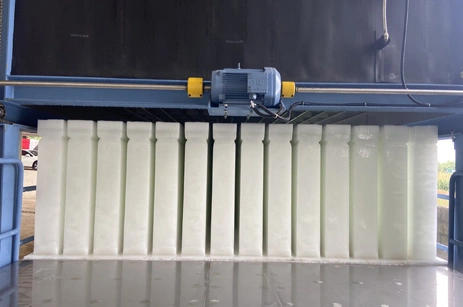
The type of ice also influences the design. Flake, tube, block, plate, and cube ice use different freezing and harvesting methods, so identical daily production ratings do not necessarily mean identical refrigeration loads, storage requirements, or power consumption. Capacity comparisons should therefore be made under clearly stated operating conditions and for the selected ice type.
Ice production requires heat to be removed from the incoming water before and during freezing. The warmer the inlet water, the more sensible heat must first be removed before freezing begins. After the water reaches its freezing point, additional heat must be removed to complete the change from liquid water to ice.
This makes inlet water temperature an important design input rather than a minor site detail. The same equipment operating with warmer supply water will face a higher refrigeration load than it would with cooler water. When comparing equipment from different suppliers, buyers should therefore check the water-temperature conditions used to establish the published production capacity.
Ambient conditions also influence the overall cooling load. Heat can enter through piping, equipment surfaces, storage rooms, and surrounding structures, while high outdoor temperatures may reduce condenser performance. These effects can become particularly important in tropical regions, coastal environments, and industrial sites where mechanical rooms already operate at elevated temperatures.
FAO technical guidance on ice-making plants notes that energy requirements vary with factors including ice type, water temperature, cooling-water temperature, air temperature, plant size, utilisation, and refrigeration method. This is why a published energy figure or capacity rating is more meaningful when the corresponding operating conditions are clearly defined.
Cooling-load assessment for an ice making plant should therefore reflect the real installation environment. Local summer temperatures, supply-water conditions, operating schedule, expected ice temperature, equipment location, and auxiliary loads all influence the capacity that the refrigeration system must actually deliver.
The refrigeration equipment must support the required freezing rate when operating conditions are most demanding, not only when ambient temperatures are mild. Compressor capacity, evaporator performance, refrigerant circulation, condenser duty, piping design, and system controls all need to work together.
An undersized ice plant refrigeration system may perform adequately during cooler periods but lose production capacity as inlet water or ambient temperatures rise. Simply oversizing every component is not necessarily a better solution. Excessive installed capacity increases investment and may result in inefficient part-load operation if the system cannot adjust effectively to changing demand.
A more practical approach is to establish realistic peak and normal design conditions and then match the refrigeration equipment to both. Where demand varies significantly, staged compressors or suitable capacity-control strategies can allow the system to respond more closely to actual production requirements.
Refrigerant piping also matters. Long pipe runs, poor insulation, unsuitable pipe sizing, and excessive pressure drop can reduce the usable capacity delivered to the ice-making equipment. ASHRAE refrigeration guidance emphasises the importance of evaluating the system as a whole rather than selecting major components independently.
FSE approaches industrial ice projects as integrated systems rather than isolated machines. Depending on the application, ice production can be combined with refrigeration equipment, ice storage, conveying, water treatment, and other process infrastructure. Businesses evaluating a new facility can review FSE's industrial ice making and refrigeration solutions to understand how these elements can be coordinated around actual production requirements.
Every refrigeration system must reject both the heat removed during ice production and the additional heat generated by compressor operation. Condenser performance therefore has a direct effect on refrigeration capacity, compressor workload, and overall system stability.
Air-cooled, water-cooled, and evaporative condensers are all used in industrial refrigeration. The correct choice depends on climate, water availability, water quality, maintenance capability, installation space, local operating costs, and project scale.
| Condenser Type | Main Advantages | Important Design Considerations | Typical Suitability |
|---|---|---|---|
| Air-Cooled | Simple installation and no condenser-water circuit | Performance depends on outdoor air temperature, airflow, coil cleanliness, and hot-air recirculation | Sites with sufficient ventilation or where water use should be limited |
| Water-Cooled | Can provide stable condensing conditions when suitable cooling water is available | Requires pumping, water-quality management, and additional heat-rejection equipment | Larger plants with suitable water infrastructure |
| Evaporative | Can provide effective heat rejection by combining air movement and evaporative cooling | Requires water treatment, regular cleaning, and control of scale and biological growth | Industrial systems where climate and water conditions support the added complexity |
Condenser location is particularly important for an air-cooled ice plant refrigeration system. If hot discharge air is trapped around the equipment and drawn back through the condenser, the entering air temperature can rise significantly above the general outdoor condition.
Designers should therefore evaluate airflow direction, equipment clearances, nearby walls or roofs, local ventilation, service access, and future cleaning requirements. Selecting a condenser only by rated heat-rejection capacity without considering installation conditions can reduce the performance of the complete plant.
Ice storage should be considered during the initial capacity calculation rather than added after production equipment has already been selected. In many applications, storage can significantly change how an ice making plant should be sized.
Demand is often uneven. Fish-processing facilities may need large quantities of ice when raw material arrives. Concrete cooling projects may experience peaks linked to batching schedules. Distribution businesses may require most of their ice during a limited loading period. In these situations, designing the ice maker to meet the entire short-duration peak directly can result in unnecessarily high installed capacity.
With suitable storage, ice can be produced in advance during lower-demand periods and held until it is required. This production buffer allows the refrigeration equipment to operate more consistently while still supporting a much higher short-term discharge rate.
The right balance between production and storage depends on how predictable demand is, available floor space, the selected ice type, acceptable storage losses, discharge requirements, and the time ice remains in storage.
Storage design itself also affects efficiency. Poor insulation, frequent door opening, warm air infiltration, unsuitable drainage, and long conveying routes can increase melting losses. In larger facilities, automatic storage and discharge systems can help coordinate continuous ice production with irregular downstream demand.
Energy efficiency in an ice making plant is not determined by one component alone. A high-efficiency compressor cannot fully compensate for poor condenser ventilation, excessive condensing pressure, unnecessary heat gain in storage, or badly insulated refrigeration piping.
The refrigeration side should first be designed to operate within appropriate evaporating and condensing conditions. Higher condensing temperatures generally increase compressor work and can reduce available refrigeration capacity. Maintaining clean condenser surfaces, sufficient airflow or water flow, and suitable heat-rejection conditions is therefore important for both capacity and energy use.
Heat gains outside the refrigeration circuit should also be reduced. Correct insulation on low-temperature piping and ice storage limits unwanted heat entering the system. Efficient conveyor layouts can shorten transfer time and reduce melting, while correctly sized fans, pumps, and motors help avoid excessive auxiliary power consumption.
Control strategy is another important factor. Where ice demand varies during the day, the ice plant refrigeration system should respond to actual production and storage conditions instead of operating at full capacity regardless of demand. Storage-level monitoring, staged compressor operation, condenser control, and coordinated production scheduling can help reduce unnecessary running hours.
Maintenance access should also be designed into the plant. Condensers, evaporators, pumps, filters, compressors, and conveying equipment require regular inspection and cleaning. Equipment that is difficult to access may gradually lose performance as heat-transfer surfaces become dirty or operating conditions move away from the original design point.
For FSE, this is why project planning should begin with operating information rather than only a requested daily tonnage. Ice type, normal and peak consumption, inlet water conditions, local climate, storage requirements, power supply, equipment layout, and discharge method all help determine a more suitable plant configuration.
A well-designed ice making plant is more than an ice machine with a sufficient nominal production rating. Reliable capacity comes from matching actual ice demand with inlet water conditions, refrigeration load, condenser performance, production schedules, storage capacity, and the environment in which the equipment will operate.
The most effective projects consider the complete system. The ice plant refrigeration system, ice-making equipment, heat rejection, piping, controls, storage, conveying, and insulation all influence final output and operating efficiency. Balancing these elements helps reduce the risk of capacity shortages while avoiding unnecessary oversizing and energy losses.
If you are planning a new industrial ice facility or expanding an existing installation, FSE can evaluate your required ice type, production volume, site conditions, refrigeration configuration, and storage requirements. Contact FSE to discuss your ice making plant requirements and develop a system around the actual operating conditions of your project.
Capacity should be based on normal and peak ice consumption, operating hours, storage capacity, production losses, seasonal demand, and site conditions. Nominal machine output alone is not enough for reliable system sizing.
Yes. Warmer inlet water requires more heat to be removed before freezing begins, increasing the refrigeration load. Equipment performance should therefore be evaluated using water temperatures that reflect the actual installation.
High ambient temperatures can make condenser heat rejection more difficult, especially in air-cooled systems. This can increase condensing temperature, increase compressor workload, and reduce available refrigeration capacity.
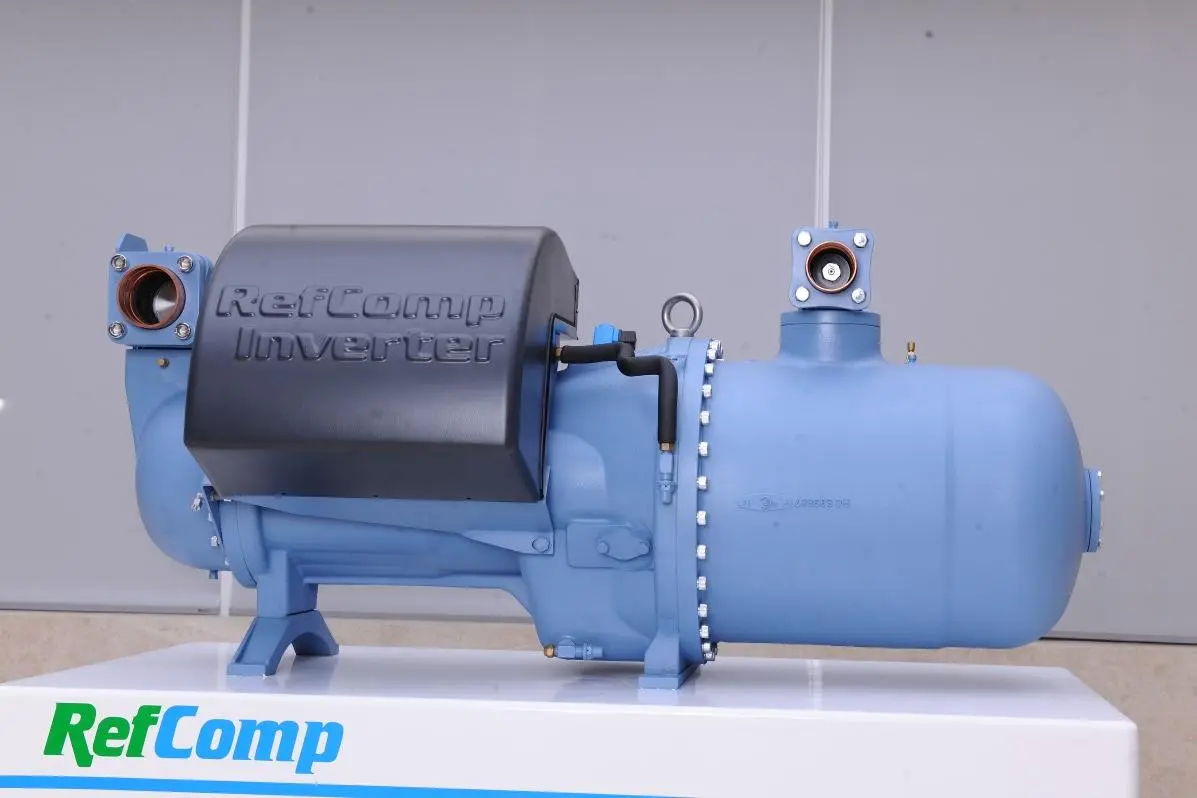
An ice plant refrigeration system can include compressors, condensers, evaporators or ice makers, receivers, refrigerant controls, pumps, piping, electrical controls, and related heat-rejection equipment.
No. When demand occurs in short peaks, suitable storage can allow ice to be produced in advance. This may provide a better balance between installed production capacity, equipment utilisation, investment, and peak ice availability.
Key measures include sizing equipment for realistic operating conditions, maintaining efficient condenser heat rejection, reducing heat gain through piping and storage, matching refrigeration output to actual demand, and coordinating production with ice storage.