search
In 2026, industrial facilities and cold storage operations face an unprecedented challenge: energy efficiency is no longer just about saving costs—it’s a survival metric. High electricity costs and water scarcity remain defining issues in choosing the right refrigeration system condenser, impacting utility bills, carbon footprint, and long-term ROI.
Picking the wrong condenser could inflate your operational expenditure by as much as 30% annually. But choosing the right one means balancing energy economics, environmental compliance, and maintenance overhead. In this article, we’ll break down how air-cooled condensers and water-cooled condensers compare in heat rejection physics, maintenance complexity, and profitability over a 5-year lifecycle.
To understand the ROI dynamic, you must first understand how condensers work. Their core function is simple: removing heat from refrigerant to condense it from a high-pressure vapor into a liquid.
When refrigerant vapor enters the condenser, it carries latent heat collected from cooled spaces. The condenser then uses heat rejection—based on the type (air or water)—to cool the refrigerant, enabling its phase change into a liquid.
A crucial efficiency metric is condensing temperature, or the temperature at which the phase change occurs. Lower condensing temperatures improve the Energy Efficiency Ratio (EER), directly reducing power consumption over time. For optimal ROI, your system should approach the lowest conceivable condensing temperature, dependent on environmental factors like dry bulb and wet bulb temperatures.
For an in-depth look into refrigeration systems and their operating principles, visit our complete guide to the working principle and types of condensers.
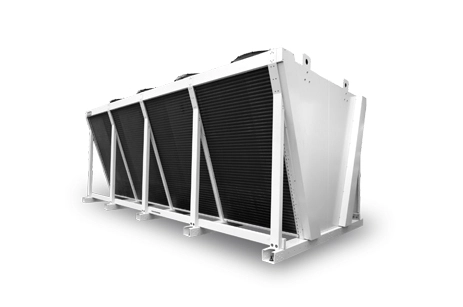
When it comes to cost-effective cooling in regions prone to water scarcity or arid conditions, air-cooled condensers tend to be the preferred solution. These systems rely on forced air movement, usually via ECM fans, to reject heat directly into the atmosphere.
Suitable for facilities with limited access to water resources.
Ideal for modular or smaller industrial applications with medium thermal loads.
Best for regions with moderate summers and consistent dry bulb temperatures.
Low Installation Costs: Simple infrastructure eliminates the need for pumps, cooling towers, or water treatment systems.
Minimal Maintenance Requirements: Cleaning fins periodically is the primary upkeep, saving labor costs.
Reduced Water Dependency: Zero water use avoids risks of scarcity and high consumption costs from makeup water.
Energy Consumption in High Temperatures: Performance declines as ambient dry bulb temperatures rise.
Bulky Design: Larger horizontal footprint compared to compact water-cooled systems.
Many modern air-cooled condensers incorporate Electronically Commutated Motors (ECMs), which dynamically adjust fan speeds based on cooling load. This feature dramatically improves energy efficiency during off-peak operation.
Water-cooled condensers dominate large-scale industrial refrigeration setups for one key reason—efficiency. Using water as the primary heat rejection medium allows these systems to achieve cooling closer to the wet bulb temperature, which is lower than the dry bulb temperature.
Designed for centralized high-capacity facilities such as cold storage, food processing plants, or chemical manufacturing.
Most effective in high ambient temperature regions where energy efficiency is critical.
Compact Design: Smaller footprint suits machine rooms and space-constrained facilities.
Superior Cooling Efficiency: Exploits water’s higher heat transfer coefficient, reducing electricity usage over time.
Consistent Thermal Performance: Independent of dry bulb conditions, making it ideal for high-load operations.
Water Treatment: Systems require chemical treatments to reduce fouling and scale within pipes.
Maintenance Complexity: Cooling towers, pumps, and descaling processes add labor costs and time.
Health Risks: Increased risk of Legionella proliferation if cooling towers aren’t properly monitored and maintained.
Which condenser delivers better ROI in 2026? The answer depends largely on energy prices and water availability. Below is a 5-year projection comparing CAPEX and OPEX for both systems.
| Feature | Air-Cooled Condenser | Water-Cooled Condenser |
| Cooling Efficiency | Lower (Relative to Ambient) | Higher (Approaching Wet Bulb) |
| Water Usage | Zero | Significant (Makeup Water) |
| Maintenance Need | Minimal (Clean Fins) | Monthly (Chemicals/Pumps) |
| Footprint | Large (Horizontal) | Compact (Machine Room) |
| Ideal Application | Dry Sites / Modular | Industrial / Centralized Load |
Air-Cooled Systems pay off faster in water-scarce areas, particularly if electricity prices per kWh are below $0.15.
Water-Cooled Systems dominate when energy prices exceed $0.20/kWh, as their efficiency offsets the added maintenance costs.
Regulatory compliance is a growing priority, especially under stricter energy efficiency and ESG mandates. Both condenser types can achieve low environmental impact using low-GWP refrigerants. However:
Air-Cooled Designs utilize fewer resources, improving Total Equivalent Warming Impact (TEWI).
Water-Cooled Models optimize energy savings over time, reducing carbon emissions from electricity usage.
By selecting the right condenser, facilities can balance operational savings with declining carbon footprints.
When deciding between air-cooled and water-cooled condensers in 2026, the choice depends on your facility’s energy economics.
Choose Air-Cooled Condensers if water access is limited, and maintenance budgets are a concern.
Opt for Water-Cooled Condensers if your facility operates in high thermal loads or focuses on long-term electricity savings.