search
A well-labeled air cooled condenser diagram is one of the fastest ways to troubleshoot capacity loss, high head pressure, fan-control issues, and refrigerant-side restrictions in real HVAC systems. By mapping the refrigerant path and airflow path together, engineers can see where heat transfer should happen — and where it is being limited. This guide explains the key components and flow logic in an air-cooled condenser diagram, plus practical notes for engineers sourcing an air cooled condenser in China for industrial or commercial projects.
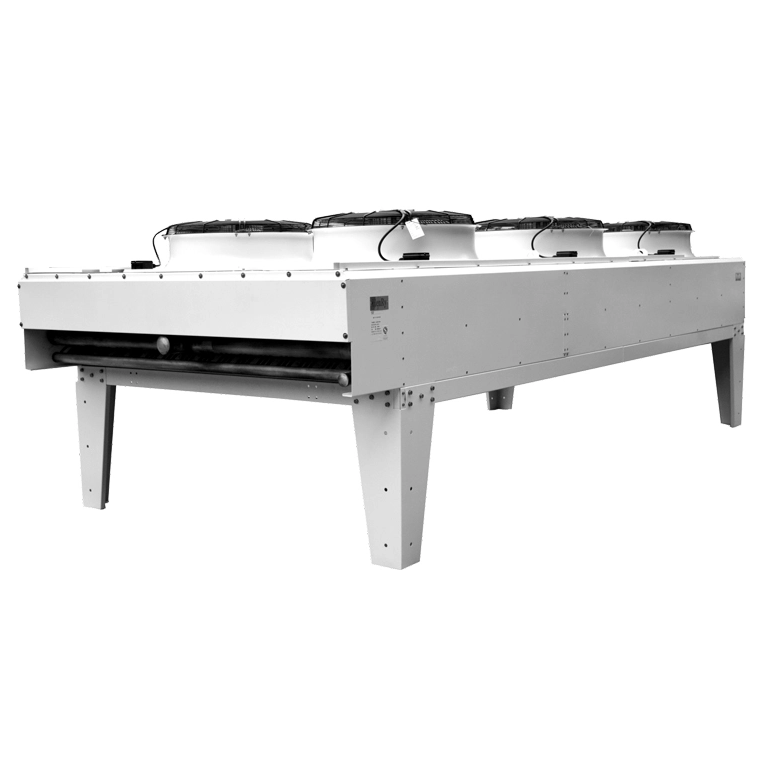
The refrigerant enters the condenser as superheated vapor from the compressor discharge and exits as subcooled liquid. A complete diagram must show all three functional zones because each behaves differently and each provides distinct diagnostic information.
| Zone | What Happens | Diagnostic Value |
|---|---|---|
| De-superheating | Superheated vapor cools toward saturation temperature | Relatively small zone; high temperature difference drives fast heat transfer |
| Condensing | Vapor condenses to liquid at near-constant saturation pressure | Largest zone; where most heat rejection occurs; temperature stays flat |
| Subcooling | Liquid cools below saturation temperature | Prevents flash gas at the expansion valve; measurable as subcooling degrees |
Hot gas inlet at the top of the coil (high-temperature vapor enters at the top in most designs to maximize driving temperature difference with entering air)
Coil circuit count and pass arrangement — multiple parallel circuits reduce pressure drop; more passes increase heat transfer
Header design — inlet manifold distributes refrigerant evenly across all circuits
Liquid outlet with sight glass position (if in the circuit schematic)
Service valve locations for isolation during service
In a well-functioning condenser, the condensing pressure corresponds directly to the saturation temperature of the refrigerant at that pressure. If the measured condensing pressure is higher than expected for the ambient temperature, the heat transfer in one or more zones is being limited — and the diagram tells you where to start looking.
| Component | Function | What to Check in the Diagram |
|---|---|---|
| Axial fans | Pull or push air through the fin coil | Number of fans; arrangement (draw-through or blow-through) |
| Fan shroud | Directs airflow through the coil; prevents bypass | Coverage area; clearance between fan blade tip and shroud |
| Finned coil surface | The primary heat transfer surface | Fin spacing; face area; depth of coil |
| Air inlet direction | Ambient air enters from one or multiple sides | Clearance requirements; recirculation risk in the installation |
| Air discharge direction | Heated air must exit without recirculating back to the inlet | Fan discharge direction (typically upward); installation height |
Airflow problems are the most common cause of high head pressure in field-installed systems. The diagram helps identify:
Recirculation: warm discharge air loops back to the air inlet — the diagram shows whether the installation layout allows this
Short-circuiting: air bypasses part of the coil surface — visible when the shroud design does not seal against the coil frame
Blocked fins: fin spacing relative to the environment (cottonwood, coastal air, industrial dust) determines cleaning frequency
The temperature difference (ΔT) between ambient air entering and air leaving the condenser is a direct indicator of fan performance and coil cleanliness. A well-performing condenser with adequate airflow shows a consistent ΔT across the coil face. Uneven ΔT across a multi-fan unit indicates a failed fan or dirty coil section.
| Design Variable | Options | Performance Implication |
|---|---|---|
| Tube type | Round copper tube; flat microchannel aluminum tube | Microchannel offers higher efficiency and lower refrigerant charge; copper tube is easier to repair |
| Fin type | Aluminum louvered; aluminum corrugated; hydrophilic coated | Louvered fins maximize air-side surface area; coatings improve water drainage |
| Circuit arrangement | Multiple parallel circuits of defined length | Shorter circuits reduce pressure drop; more circuits allow variable staging |
| Header design | Inlet and outlet headers; intermediate headers for multi-row designs | Even refrigerant distribution across circuits; critical for capacity and performance rating accuracy |
An air cooled condenser in China supplied for coastal, industrial, or chemically aggressive environments must specify the correct protection system — not just "standard" coil.
| Environment | Recommended Protection | What to Specify |
|---|---|---|
| Standard inland commercial | Aluminum fins on copper tubes; no additional coating | Standard AHRI-rated unit |
| Coastal (salt fog) | Epoxy-coated fins; or copper fin option | Blue fin, gold fin, or copper fin specification |
| Industrial (ammonia, chemicals) | Full epoxy electrostatic coating over assembled coil | Specify post-assembly coating; confirm chemical compatibility |
| High-humidity tropical | Hydrophilic fin coating to promote drainage | Specify hydrophilic coating grade |
Performance data at your design ambient temperature, not just at 35°C standard rating conditions
Pressure test standard and test pressure applied during production
Leak test method (pressure decay or helium leak test for sensitive applications)
Coating material specification and adhesion test results if coated coil is specified
A complete system diagram connects the condenser to its control devices. These are not shown on the condenser product diagram but should appear on the system schematic that engineers use for commissioning and troubleshooting.
| Control Device | Function | Location in Diagram |
|---|---|---|
| High-pressure cutout switch | Shuts down the compressor if condensing pressure exceeds safe limit | Compressor discharge line or condenser inlet header |
| Condensing pressure transducer | Measures operating condensing pressure for system monitoring and fan control | Discharge line or liquid line at the condenser outlet |
| Fan staging relay or controller | Cycles fans on and off to maintain target condensing pressure | Control panel; connected to pressure transducer |
| EC fan speed controller or VFD | Variable fan speed for precise head pressure control | Integral to EC fan motor or separate VFD panel |
| Service valves | Isolate condenser for maintenance | Inlet and outlet of the condenser; discharge from compressor |
The expansion valve (TXV or EEV) controlling refrigerant flow into the evaporator requires a minimum pressure differential to operate correctly. If head pressure drops too low in cool ambient conditions, the expansion valve cannot maintain adequate superheat control, leading to liquid flood-back or loss of evaporator capacity. If head pressure rises too high, compressor efficiency drops and discharge temperature rises toward safety limits.
Fan staging and variable-speed fan control, shown in the system diagram as a control loop between the pressure transducer and the fan controllers, is the mechanism that maintains head pressure within the acceptable operating band.
| Input Parameter | What It Determines | Notes |
|---|---|---|
| Heat rejection load (kW) | Total condenser capacity required | Total of refrigeration capacity plus compressor power |
| Refrigerant type | Coil circuiting, operating pressure range, material compatibility | R410A, R32, R134a, R22 (retrofit), R448A all have different saturation curves |
| Design ambient temperature | Condensing temperature and approach temperature | Size for peak ambient — not average |
| Allowable approach temperature | Difference between condensing saturation temp and ambient | Lower approach = larger coil = higher cost; typically 8–15°C |
| Available installation area | Determines number and arrangement of condenser units | Multiple smaller units may be preferable to one large unit for redundancy |
Clearance: minimum clearance above the fan discharge (typically 1–2 fan diameters) and on air inlet sides (typically 600–1000 mm minimum) to prevent recirculation
Orientation: air inlet faces must not face prevailing wind direction in locations with strong consistent winds — pressure on the inlet face reduces effective airflow
Noise: distance from noise-sensitive areas; acoustic enclosure options if required
Maintenance access: full panel removal access on at least one long face; fan motor access from above or side
Leak test the refrigerant circuit before charging
Verify fan rotation direction by observing discharge direction — air must discharge away from the unit, not recirculate
Measure air-side ΔT across the coil face at initial startup under load
Confirm subcooling in the liquid line — typically 5–10 K below saturation for most systems
Establish a coil cleaning schedule based on the installation environment
For HVAC engineers, an accurate air cooled condenser diagram turns a complex heat-rejection device into a predictable system — you can follow the refrigerant through its three thermal zones, validate airflow direction and fan arrangement, and pinpoint where performance is being lost before opening a service valve. When sourcing an air cooled condenser in China, use the diagram-driven approach to confirm coil circuiting, material and coating specifications, control integration, and installation clearance requirements so the installed unit matches your design conditions.
Q1: What should an air cooled condenser diagram include for engineering use?
A complete diagram should show the refrigerant inlet (hot gas from compressor), the coil circuit arrangement with pass count, the three thermal zones (de-superheating, condensing, and subcooling), the liquid refrigerant outlet, fan positions and airflow direction, air inlet and discharge sides, and the locations of key control devices including the high-pressure cutout and condensing pressure transducer.
Q2: How does airflow affect condenser head pressure?
Reduced airflow decreases the rate of heat rejection from the refrigerant, which causes the condensing temperature to rise to compensate. The higher condensing temperature corresponds to a higher condensing pressure — measured as elevated head pressure. Common causes of reduced airflow include dirty or blocked fins, incorrect fan rotation, insufficient installation clearance causing recirculation, and failed fans.
Q3: What is the difference between the condensing and subcooling zones in the coil?
In the condensing zone, refrigerant vapor changes phase to liquid at near-constant saturation temperature and pressure — this zone rejects the largest portion of heat. In the subcooling zone, the liquid refrigerant is further cooled below its saturation temperature. Subcooling improves system efficiency and prevents flash gas formation in the liquid line before the expansion valve.
Q4: What should I verify when buying an air cooled condenser in China?
Confirm performance rating at your actual design ambient temperature (not just at the standard 35°C test condition), coil material and fin material specification, corrosion protection coating type if the environment requires it, pressure test standard and test pressure applied during production, fan motor efficiency class and control compatibility, and required installation clearances.
Q5: What are the most common causes of poor air-cooled condenser performance?
Dirty or blocked coil fins reducing heat transfer area, recirculation of warm discharge air back to the air inlet due to insufficient clearance, undersized condenser capacity for the actual heat rejection load, incorrect or failed fan staging control causing excessive head pressure variation, refrigerant circuit restrictions or incorrect charge affecting zone distribution, and coil corrosion reducing fin contact efficiency over time.