search
In large-scale commercial cooling, heavy manufacturing, and cold chain logistics, the performance of the entire system hinges on the reliability of its central compression hardware. Industrial cooling systems require continuous, uninterrupted operation under varied seasonal thermal loads. To meet these rigorous demands, engineering procurement managers and facility operators consistently rely on the screw compressor as the core powerhouse of their mechanical refrigeration loops.
Selecting and integrating the right compression unit requires a clear understanding of its mechanical design, thermodynamic capabilities, and application parameters. Partnering with an experienced supplier to source a premium screw compressor in china allows global enterprises to implement robust, high-efficiency refrigeration machinery tailored to demanding environmental conditions while keeping lifetime operational costs low.
An industrial refrigeration screw compressor is a positive-displacement machine designed to handle continuous-duty, high-capacity cooling workloads. Unlike reciprocating compressors that rely on pistons and valves, or centrifugal units that utilize high-speed impellers, a screw compressor uses rotary mechanisms to achieve gas compression.
The primary function of this machine within a refrigeration loop is to pull low-pressure, low-temperature refrigerant gas from the evaporator, compress it mechanically, and discharge it as a high-pressure, high-temperature gas into the condenser. Because of their valveless design, these units process massive volumetric flows of vapor smoothly, making them the standard choice for facilities requiring refrigeration capacities ranging from tens of kilowatts to several megawatts.
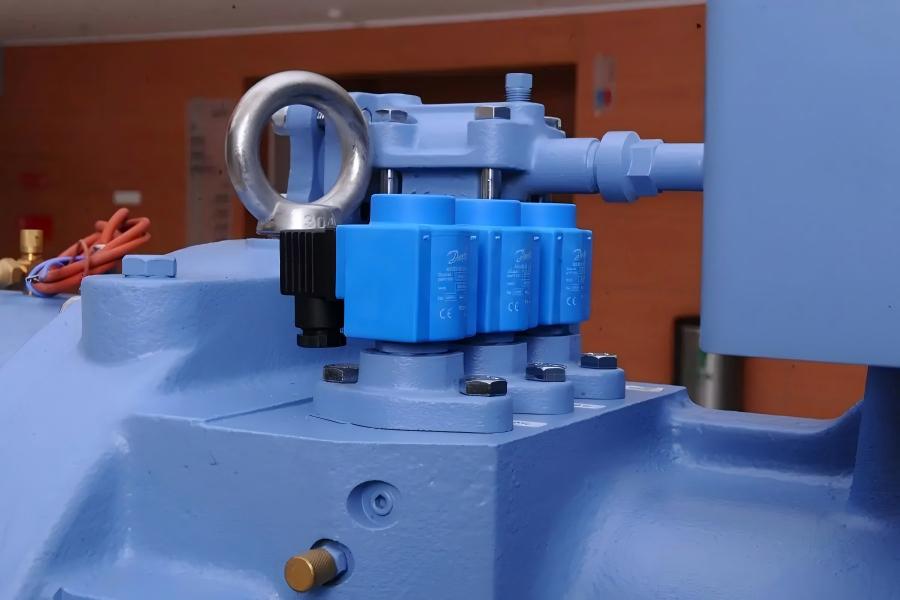
The working principle of an industrial refrigeration screw compressor revolves around two intermeshing helical rotors—typically designated as the male rotor and the female rotor—housed securely within a precision-machined casing. The male rotor generally features four or five helical lobes that mesh precisely into the five or six corresponding flutes of the female rotor.
The internal compression cycle follows a continuous, three-phase physical progression:
Suction Phase: As the rotors turn away from each other, the volume between the helical lobes and flutes expands at the intake end of the casing. This expansion creates a localized vacuum that draws low-pressure refrigerant vapor from the suction line into the open inter-lobe voids.
Compression Phase: As rotation continues, the trapped volume of gas is sealed off from the suction port by the casing walls. The counter-rotating mesh of the rotors progressively reduces the physical space available between the lobes. This continuous volumetric reduction compresses the trapped refrigerant gas, steadily increasing both its pressure and internal temperature.
Discharge Phase: Once the compressed gas reaches the built-in volume ratio dictated by the geometry of the machine, the inter-lobe space aligns precisely with the discharge port of the housing. The high-pressure refrigerant vapor is then pushed smoothly into the discharge line without pressure pulsations.
During this cycle, oil injection is utilized within the compression chamber. The injected oil seals the clearances between the spinning rotors, cools the gas during compression to manage discharge temperatures, and lubricates the heavy-duty bearings, ensuring quiet and durable continuous operation.
Industrial refrigeration screw compressors offer distinct mechanical advantages over alternative compression technologies, making them highly efficient assets for heavy industries:
Continuous-Duty 24/7 Reliability: Because the rotary compression mechanism contains no reciprocating parts or volatile valves, the mechanical stress profile is exceptionally balanced. This structural stability minimizes vibration and extends scheduled overhaul intervals up to 50,000 running hours.
Superior Part-Load Efficiency: Modern screw compressors incorporate an internal slide valve mechanism that mechanically alters the suction port length. This allows the machine to achieve infinite, step-less capacity regulation from 10% to 100%, dynamically matching power draw to actual thermal loads.
High Volumetric Efficiency: The continuous injection of oil ensures tight clearances between the rotors are maintained. This hydraulic sealing prevents compressed gas from leaking back toward the suction side, keeping volumetric efficiency exceptionally high across a wide range of pressure differentials.
When sourcing a high-performance screw compressor in china, engineers choose between several structural and configuration types based on system architecture and operational demands.
| Compressor Type | Mechanical Characteristics | Primary Advantage | Typical Application |
|---|---|---|---|
| Semi-Hermetic Screw | Integrated Motor inside the Casing; No Shaft Seal Required | Zero Refrigerant Leakage Risk | Commercial HVAC & Medium Cold Storage |
| Open-Drive Screw | External Motor Connected via Flexible Coupling | Compatible with Ammonia (R717); Easy Motor Swap | Large Industrial Food Processing & Chemical Loops |
| Single-Stage Configuration | Uses a Single Pair of Rotors to Compress Gas | Low Complexity; Highly Cost-Effective | High-to-Medium Evaporating Temperature Systems |
| Two-Stage Configuration | Passes Gas Through Low-Pressure and High-Pressure Rotors | High Efficiency at Extreme Pressure Ratios | Ultra-Low Temperature Blast Freezers (-40°C or Lower) |
The exceptional adaptability, continuous performance, and high capacity ratings of rotary screw systems make them essential components across several capital-intensive sectors:
Cold Chain Storage and Logistics: Large distribution hubs require stable temperature regulation to preserve thousands of tons of perishable inventory. Large screw compressor racks manage these extensive evaporator networks seamlessly, maintaining uniform suction pressures across vast cooling zones.
Food and Beverage Processing Facility Operations: From fast-acting spiral freezers in poultry plants to massive chilling tunnels in industrial breweries and dairies, screw compressors deliver the rapid thermal extraction necessary to safeguard product hygiene and shelf life.
Chemical and Gas Processing Loops: Chemical synthesis often generates intense exothermic reactions. Heavy-duty open-drive screw units manage specialized process fluid cooling and gas liquefaction under hazardous conditions, running reliably alongside explosion-proof auxiliary systems.
Selecting the correct compressor model requires balancing thermodynamic parameters to optimize future electricity consumption. First, identify your exact evaporating and condensing temperatures under worst-case local summer conditions. If your system requires deep freezing at extreme pressure ratios, opt for a model equipped with an economizer circuit or a two-stage configuration to prevent high discharge temperatures and maximize your Coefficient of Performance (COP).
Second, verify refrigerant compatibility. Synthetic options pair well with semi-hermetic designs, but if your plant utilizes natural Ammonia (R717) due to environmental mandates, you must select an open-drive model equipped with independent oil separation and thermosiphon oil coolers. Finally, look for built-in Variable Frequency Drive (VFD) compatibility. Combining VFD speed regulation with internal slide valves provides an efficient compound capacity regulation system, cutting power consumption during off-peak evening hours.
Fujian FSE Supply Chain Management CO., Ltd. (FSE) is a comprehensive industrial platform specializing in heavy-duty cold chain hardware, automated manufacturing assets, and tailored turnkey engineering. We work directly with global engineering firms and plant operators to deliver heavy-duty compression systems built to withstand demanding industrial environments. Our portfolio features robust, precision-engineered twin-rotor units designed for maximum volumetric performance and low maintenance requirements.
The CSAC compression series is purposefully engineered for containerized transportation, fitting seamlessly into 20-foot to 40-foot containers. The equipment easily disassembles into three sub-assemblies for shipping, which minimizes ocean freight costs and dramatically accelerates on-site installation and deployment. Explore our complete selection of high-performance Refrigeration Equipment.
To secure a robust refrigeration layout optimized for low total cost of ownership, reach out to our engineering support division today. We provide precise thermodynamic load assessments, oil management schematics, and tailored commercial proposals designed around your specific facility parameters. Contact us through our official Contact Page to begin your technical consultation.
Industrial refrigeration screw compressors provide the structural reliability, step-less capacity flexibility, and volumetric performance required by modern commercial cooling and heavy industrial processing loops. Vetting equipment parameters based on exact compression ratios, component metallurgy, and smart automation ensures your system runs efficiently for decades. Partnering with a dedicated technical platform like FSE guarantees that your compression assets are integrated into a high-performance system designed for minimal maintenance and maximum energy savings.
With routine oil testing, timely filter changes, and proper operating conditions, a premium industrial screw compressor can run for 15 to 20 years. The first scheduled bearing inspection or major overhaul typically occurs between 40,000 and 50,000 running hours.
Unlike other models, a screw compressor injects oil directly into the compression chamber to seal the small clearances between the rotors, dissipate heat, and lubricate bearings. An efficient external oil separator is essential to ensure this oil is removed from the discharge gas before it enters the condenser.
Yes. Open-drive screw compressors are highly preferred for industrial ammonia (R717) systems. Because ammonia is corrosive to copper, open-drive units isolate the motor windings from the refrigerant flow, utilizing external couplings and steel internal components.
An economizer introduces a small portion of flash gas from a subcooler directly into an intermediate port during the compression stroke. This subcools the liquid refrigerant before it enters the evaporator, increasing the total refrigeration capacity and enhancing overall system COP by up to 20% in low-temperature applications.
NEXT