search
Seafood begins losing quality soon after harvest, which makes temperature management one of the most important parts of processing. From fishing vessels and landing areas to grading lines, processing plants, cold rooms, and distribution, the objective is to remove heat quickly and prevent the product temperature from rising again during handling.
Flake ice is widely used for this purpose because its thin, irregular pieces can spread over fish and shellfish and create close contact with the product surface. Unlike larger pieces of ice that may leave air gaps, flake ice can surround seafood more evenly, helping remove heat while reducing the risk of physical damage to delicate products.
For seafood processors, however, selecting a flake ice machine is not simply a matter of choosing the highest production capacity. Ice quality, food-contact hygiene, storage, drainage, ambient conditions, peak processing volume, and the surrounding refrigeration system all influence how effectively the equipment protects seafood freshness.
Rapid chilling is particularly important immediately after seafood is harvested or enters a processing facility. Fish continues to undergo biochemical and microbiological changes after death, and higher temperatures generally accelerate quality deterioration. Removing field or harvest heat as early as practical therefore helps processors maintain texture, appearance, and overall product quality through subsequent stages.
FAO guidance on fresh fish handling recommends chilling fish toward 0°C as quickly as possible. In practice, the exact temperature-control programme should depend on species, processing method, regulatory requirements, transport duration, and the company's HACCP plan. FDA seafood guidance also uses 4.4°C, or 40°F, as an important temperature threshold in several refrigerated seafood handling and receiving control strategies.
A flake ice machine supports rapid chilling by producing small flakes that can be distributed between layers of seafood rather than simply placed on top of a container. When ice surrounds more of the product, heat can transfer from the warmer seafood to the colder ice across a larger effective contact area.
This is useful at several points in seafood operations. Fresh catch can be iced soon after landing, raw materials can be re-iced after sorting or washing, and processed seafood can receive additional ice before temporary storage or shipment. The purpose is not to replace the plant's entire refrigeration system, but to provide localised cooling directly where the product needs it.
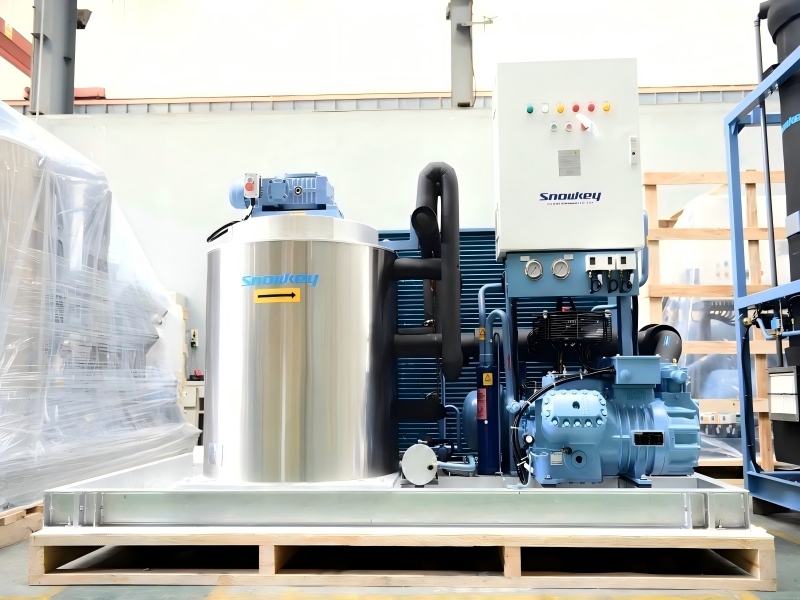
The shape of the ice matters because cooling occurs primarily through heat transfer at the interface between the seafood, ice, and cold meltwater. Thin flakes conform more easily to irregular product shapes than large ice pieces, allowing the cooling medium to reach more of the fish surface.
FAO technical guidance notes that flake ice can cool fish more rapidly than crushed block ice in direct-contact applications because of its shape and surface characteristics. Flake ice also requires no crushing before use, which can simplify handling in operations where large quantities of ice need to move continuously from production to packing or processing areas.
This does not mean flake ice is automatically the best option for every cooling requirement. Its relatively rapid melting is advantageous when quick heat removal is the priority, but other forms of ice may be selected when slower melting or greater cooling capacity within a limited storage volume is more important.
| Cooling Medium | Product Contact | Cooling Behaviour | Handling Considerations | Typical Seafood Use |
|---|---|---|---|---|
| Flake Ice | High contact because flakes conform around seafood | Rapid heat removal during direct contact | No crushing normally required; easy to distribute | Fresh fish, shellfish, processing lines, packing and short-term chilled handling |
| Crushed Block Ice | Depends strongly on crushing size and distribution | Effective when crushed into sufficiently small pieces | Requires crushing equipment or an additional handling step | Fish storage and transport where block ice is already readily available |
| Tube Ice | Lower conformity around irregular product surfaces | Generally slower cooling than well-distributed flake ice | Dense and relatively easy to store and transport | Applications where slower melting and longer cooling duration may be preferred |
For processors evaluating a new flake ice machine, the practical question is therefore not only how many tonnes of ice the unit produces. The more useful question is whether the generated ice can be delivered evenly and consistently to the product at the points where heat actually needs to be removed.
Rapid initial chilling is only the first step. Seafood can warm again while waiting for grading, during manual handling, on packing lines, inside temporary storage areas, or during transfer to refrigerated vehicles. Effective temperature management therefore depends on maintaining a continuous cold chain rather than relying on a single cooling stage.
Flake ice can act as a local thermal buffer around seafood. As ice absorbs heat and melts, it helps control temperature at individual contact points around the product. This is especially useful in boxes and containers where chilled air alone may not provide perfectly uniform cooling around every fish.
However, the performance of ice should be supported by appropriate insulation and refrigeration. Using large quantities of ice to compensate for poorly insulated containers, excessive exposure to warm ambient conditions, or inadequate cold-room performance can increase operating costs without solving the underlying cold-chain problem.
A more efficient approach is to treat the flake ice machine, ice storage, refrigerated processing areas, cold rooms, and transport equipment as parts of one temperature-management system. FSE applies this system-level approach across industrial ice making and cold-storage projects. Seafood businesses planning a new facility or upgrading an existing one can review FSE's industrial refrigeration and ice solutions when considering how ice production should integrate with storage and processing requirements.
This integration becomes more important as processing volume increases. If the machine produces sufficient ice but the storage or conveying arrangement cannot deliver it when the line reaches peak throughput, the operation can still experience local shortages and temperature fluctuations.
Because ice can come into direct contact with seafood, hygiene should receive the same attention as other food-contact materials and process water. Water used to manufacture food-contact ice should be safe and suitable for its intended use, while the machine, storage area, discharge points, tools, and conveyors should be incorporated into routine sanitation procedures.
A hygienic flake ice machine installation should also minimise opportunities for contamination after the ice leaves the evaporator. Open storage areas, dirty scoops, poorly cleaned conveyors, standing water, and unnecessary manual handling can undermine the benefit of producing clean ice in the first place.
Meltwater management is equally important. Meltwater contributes to heat transfer, but it must be able to drain away effectively. FAO guidance specifically warns against allowing fish to remain immersed in contaminated drainage water. Seafood boxes, bins, working areas, and ice-storage systems should therefore be designed so that water does not accumulate around the product.
Processors should also establish routine checks appropriate to their HACCP and sanitation programmes. Instead of judging ice quality only by appearance, operators should verify water supply conditions, cleaning procedures, drainage, storage hygiene, and equipment condition. Where food-safety regulations or customer standards require additional microbiological or sanitation verification, these checks should be incorporated into documented quality-control procedures.
For seafood plants, this means that purchasing decisions should cover more than the refrigeration components themselves. The sanitary design of the surrounding ice-handling system can have a direct effect on how reliably the finished installation supports product quality.
Correct capacity selection is one of the most important decisions when specifying a flake ice machine. A machine that is too small can create shortages during peak landings or production shifts. Oversizing, on the other hand, may increase capital cost and leave equipment operating far below its intended utilisation for much of the year.
The starting point should be actual seafood throughput. Processors need to understand typical daily volume, peak-season volume, operating hours, number of shifts, incoming seafood temperature, time before refrigerated storage, and the points in the process where ice is added. Ice used for initial chilling should also be distinguished from ice needed for re-icing, display, temporary holding, or transport.
Storage capacity is another factor. The ice machine does not necessarily need to match the highest short-term hourly demand if sufficient hygienic ice storage is available to build inventory before the processing peak. Conversely, a machine with adequate nominal daily production may still cause shortages when there is little storage and demand is concentrated into only a few hours.
Ambient temperature and water temperature can also affect refrigeration performance, so nominal output should be reviewed against the operating conditions expected at the actual installation site. Buyers should compare rated capacity under clearly stated conditions rather than treating every published tonnes-per-day figure as directly equivalent.
This is also important when procurement teams perform supplier research using company-specific searches such as Flake Ice and Refrigeration Systems Private Limited as well as broader terms such as industrial flake ice equipment. Supplier comparison should focus on measurable project requirements: usable output under expected site conditions, refrigeration configuration, corrosion resistance, sanitation, automation, storage integration, maintenance access, and technical support.
In other words, comparing FSE with other suppliers, including companies found through searches for Flake Ice and Refrigeration Systems Private Limited, should be based on the complete seafood cooling requirement rather than the machine name alone. This produces a more meaningful evaluation of lifecycle suitability and reduces the risk of selecting equipment that performs well on paper but does not fit the actual production workflow.
FSE offers both freshwater and seawater flake ice equipment for different operating environments and can combine ice making with storage and refrigeration systems. For a seafood project, the most useful equipment specification should therefore begin with the processing conditions rather than a predetermined machine size.
Flake ice is effective in seafood processing because it combines close product contact with rapid heat removal and convenient distribution. When applied correctly, it can support fast chilling after harvest, help control temperature during processing and handling, and provide localised cooling during storage and transport.
The value of a flake ice machine, however, depends on more than its nominal ice output. Reliable seafood cooling requires appropriate capacity, hygienic water and ice handling, effective meltwater drainage, adequate storage, and integration with the wider refrigeration system.
For processors planning a new seafood facility or expanding production, equipment should be sized around actual throughput, peak demand, operating environment, ice-use points, and cold-chain requirements. FSE can evaluate these project conditions and develop an appropriate ice-making and refrigeration configuration. To discuss production capacity, installation conditions, or a customised seafood cooling project, contact FSE for a project assessment.
Flake ice has thin pieces that spread easily over irregular seafood surfaces. The close contact improves heat transfer, helping fish and shellfish cool quickly while reducing the risk of damage from large, hard ice pieces.
Fresh fish should generally be chilled toward 0°C as quickly as practical, according to FAO guidance. Specific legal and HACCP temperature limits depend on the seafood product, processing method, market, and stage of the cold chain.
Flake ice is particularly useful when rapid cooling and close product contact are priorities. Crushed block ice can also cool seafood effectively when it is crushed finely and distributed properly. The better option depends on processing, storage, transport, and local ice-supply requirements.
Calculate demand from typical and peak seafood throughput, operating hours, incoming product temperature, ice application points, storage capacity, and transport requirements. Machine output should also be checked under the expected ambient and water-temperature conditions.
Compare usable ice output, operating conditions, refrigeration configuration, sanitary design, corrosion resistance, storage integration, automation, maintenance requirements, and technical support. Buyers researching suppliers such as Flake Ice and Refrigeration Systems Private Limited should compare these practical parameters rather than relying only on advertised daily capacity.
No. Flake ice and refrigerated storage perform complementary functions. Ice provides direct cooling around seafood, while cold rooms and refrigerated transport control the surrounding environment. A well-designed seafood cold chain normally coordinates both systems.